
The Reading Doctor
For Families
We find why your child struggles.
Then we fix it.
Most reading apps give more practice. We start by finding the missing skill.
The Reading Doctor identifies your child’s underlying reading gaps and provides targeted practice to help close them at home.
Sample report · from The Reading Dr.
Reading level identified
1st grade
3 gaps found · starting with the one that matters most
The Dr.'s next steps
First up: silent-e words — one short game, then a five-minute at-home tip (no teaching required).
Start the free Reading Check-Up
A sample Reading Check-Up — yours is built from your child's actual answers.
Free Reading Check-Up · No login required to start
Built by two certified reading specialists
Measures the same skills schools screen for — aligned with DIBELS benchmarks and the Wilson phonics teaching sequence
Learning English? Your child reads in English — you don’t need English to help.
Directions, labels, and at-home tips are in your language. The reading activities stay in English so the results stay accurate. Tap your language to see it now.
One plan, home + school
You don’t need to become a reading teacher
The prescribed plan tells you exactly what to say and why it works — in about 15 minutes a day.
The Reading Doctor identifies your child’s underlying reading gaps and provides targeted practice to help close them at home.
And when your child has a teacher, you can share the diagnosis and progress with one email — so home and school work from the same picture, not separate ones.
At home
A short, prescribed session each day — follow the script, and the plan handles the teaching. No teaching background needed.
At school
When your child has a teacher, share the diagnosis and progress with one email — so both sides work from the same picture, not separate ones.
Try it now — no sign-up, no email
Sit with your child and watch them play
Pick your child’s grade below — they’ll be playing a real reading game from the app in seconds.
Pre-K & Kindergarten
Letter Sounds
Hear a sound, find the letter that makes it
Play nowGrades 1–2
Word Match
Match words to their pictures
Play nowGrades 3–4
Homophones
Pick the right sound-alike word
Play nowGrades 5–6
Word Roots
Unlock big words with Greek & Latin roots
Play nowIf your child seems bored, frustrated, or worn out, the games notice — and respond with encouragement, not pressure. All with no cameras, no microphones, and no data collection.
Playing is always free. When you’re ready, the free reading check finds your child’s exact gaps and builds their full plan.
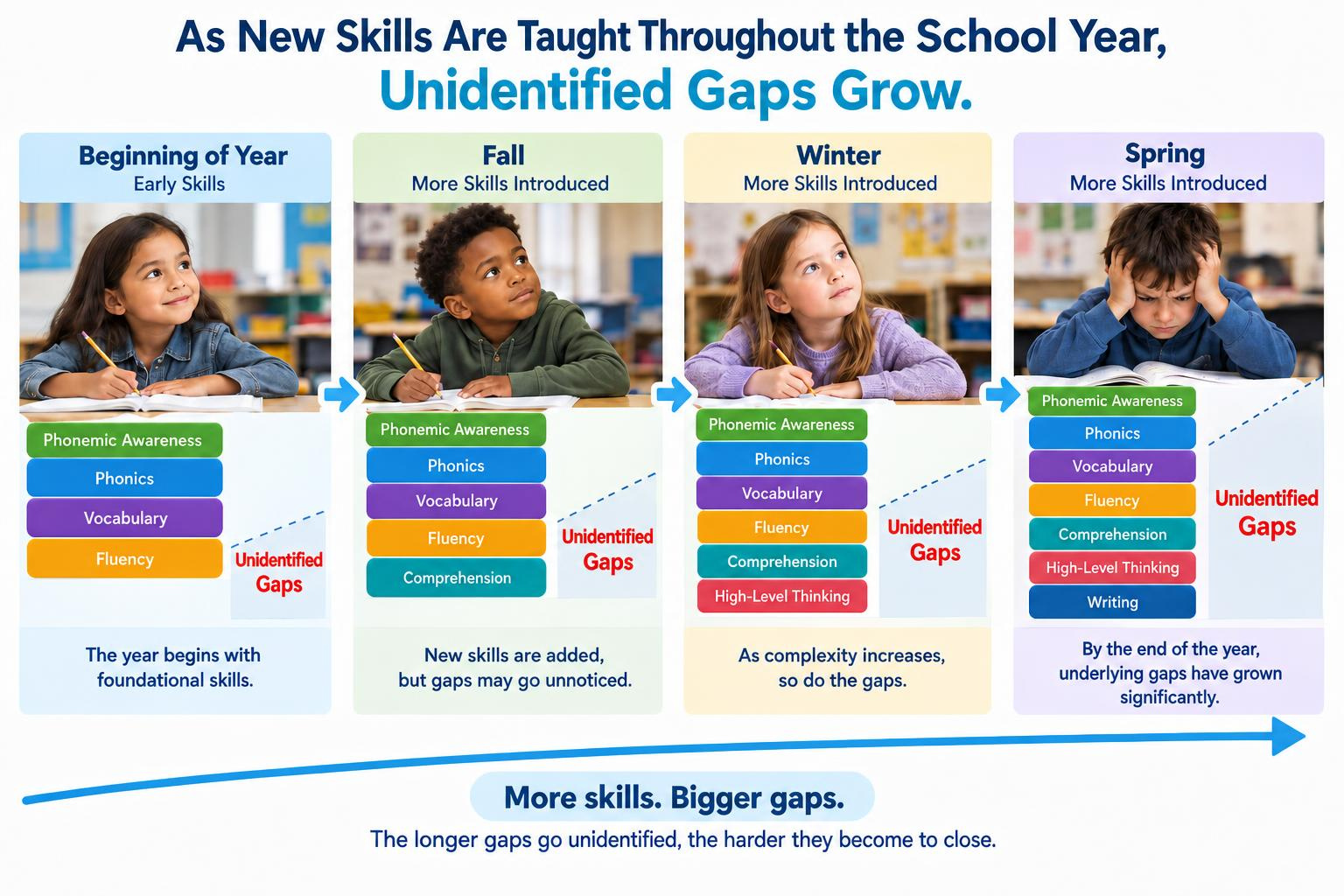
Your child may know the skill—but still have underlying reading gaps.
A child can appear to understand a skill in class while underlying reading gaps continue to affect reading fluency, comprehension, independent work, or assessment performance.
What a targeted fix looks like
She was stuck guessing at every long word. The Check-Up showed she was missing silent-e — one specific gap, not “reading trouble.” Three weeks of 15-minute games later, she was reading at a higher reading level.
The Check-Up finds your child's specific gap — the plan starts with the one that matters most.
Start the free Reading Check-UpHow It Works
Check. Prescribe. Prove.
Check — Find the Gap
A free reading check pinpoints the underlying gaps holding your child back — measured against the same skills schools screen for.
Prescribe — One Next Step
No menu of games. You get one recommended activity for your child's biggest gap, plus a five-minute tip to reinforce it at home — no teaching required — and the games themselves respond kindly if your child gets bored or frustrated.
Prove — See the Growth
A printable family progress report shows reading-level growth and reading speed vs. grade-level goals — ready for teacher conferences, or send it straight to your child's teacher.
Whatever's getting in the way, there's a targeted fix
Parents tell us the struggle in their own words. We map it to the underlying skill — then practice exactly that skill.
Phonics & decoding
“Guesses at long words instead of sounding them out”
Fluency
“Reads slowly, word by word, with visible effort”
Comprehension
“Reads the words but misses the meaning”
Vocabulary
“Has a small bank of everyday words”
Writing
“Knows the answer but can't get it onto paper”
Grammar
“Skips over endings, tenses and word forms”
The free Reading Check-Up pinpoints which of these your child needs first.
Start the free Reading Check-UpHome and school, pulling together
Put your child’s teacher in the loop
After the free reading check, share your child’s results and progress with their teacher in one email — you choose exactly what they see, and you can stop sharing anytime. When home and school work from the same picture, gaps close faster.
Start My Child’s Free Reading CheckTake The Reading Doctor anywhere — add it to your phone in under a minute.
Reading help for parents
Straight answers about your child's reading
Short, practical guides from certified reading specialists — what's normal, what's a warning sign, and exactly how to help at home.
Early Readers
CVC Words: What They Are and How to Help Your Child Read Them
CVC words like cat, sun, and big are your child's first real reading milestone. Learn what they are, why they matter, and five playful ways to practice at home.
Read the article 5 min readEarly Readers
Teaching Predictions: The First Active-Reading Skill Tests Look For
Good readers start before the first sentence, predicting what the story will be about. Here's a simple way to teach that skill tonight.
Read the article 5 min readEarly Readers
Teaching Story Setting: The 'Where and When' Question on Every Test
Setting is one of the first story elements reading tests ask about. Six playful activities — scavenger hunts, sensory guessing, drawing challenges — that make it stick.
Read the article 6 min readGrowing Readers
7 Signs Your 2nd Grader Is Behind in Reading (and What to Do Next)
Guessing words, choppy reading, avoiding books? Learn the seven research-backed signs that a second grader is falling behind in reading — and the simple first step to catch up.
Read the article 7 min readGrowing Readers
My Child Reads Just Fine — So Why Is He Failing Reading Tests?
Your child reads aloud smoothly but fails reading tests. The disconnect is real and common — decoding without comprehension — and here's what to do about it.
Read the article 6 min readGrowing Readers
Reading Comprehension Activities You Can Do at Home
Eight simple, proven reading comprehension activities — from shared reading to story maps — that turn reading time into understanding time. No worksheets required.
Read the article 6 min readGrowing Readers
Why Did the Character Do That? Teaching Kids to Read Between the Lines
Reading tests constantly ask why a character did something — a question about inference. Build that skill through everyday conversation, starting tonight.
Read the article 6 min readGrowing Readers
Problem and Solution: The Question Hiding in Every Reading Test
Reading tests almost always ask about the problem in a story — kids who can spot it sail through. Here's how to teach it, with practice that works anywhere.
Read the article 6 min readGrowing Readers
Story Plot: Teaching Beginning, Middle, and End (and the Five Parts Tests Ask About)
Plot questions trip up young test-takers more than almost any other kind. Story maps, sequencing games, and the five plot elements — explained for parents.
Read the article 6 min readGrowing Readers
How to Grow Your Child's Vocabulary (Without Flashcard Marathons)
Vocabulary is the quiet engine of comprehension. Eight practical ways to build it at home — word teaching, word walls, read-alouds, and playful exposure.
Read the article 6 min readGrowing Readers
Dyslexia: What Actually Helps (and What Doesn't)
Dyslexia isn't a phase and isn't about intelligence — and it isn't 'cured' either. What the evidence supports: early screening, structured literacy, real support.
Read the article 6 min readGrowing Readers
The Summer Slide Is Real: How to Keep Your Child Reading (and Growing) All Summer
Children who don't read over summer lose months of reading growth — and it compounds yearly. Five simple routines that stop the slide, no worksheets.
Read the article 5 min readConfident Readers
Is Your Child Really Getting Anything Out of What They Read?
Fluent reading isn't deep reading. Five home habits — sticky notes, connections, background knowledge, questions, visualization — turn reading into understanding.
Read the article 6 min readCommon questions from parents
Ready to see what's actually blocking your child's reading? Start the free Reading Check-Up
Popular skill guides: CVC words · Sight words · Silent e · Syllables · Reading fluency · Comprehension
Contact us
Questions about your child's reading journey? Send us a message — we're happy to help.
IDENTIFY THE UNDERLYING READING GAPS.
PRESCRIBE THE ONE NEXT STEP.
CLOSE THE GAPS.
SEE THE PROOF IN A PRINTABLE FAMILY REPORT.
BUILD CRITICAL READING SKILLS.
MLL Students… Dyslexia… Special Ed… Struggling Readers